
We provide flexible research solutions tailored to each client’s
objectives, context, and decision-making needs.
Myriad’s quantitative research is designed to deliver robust, decision-ready evidence, grounded in sound measurement, sampling, and statistical analysis. We use fit-for-purpose survey and assessment tools to quantify behaviours, outcomes, and market or programme performance, producing results that can be confidently used for business and policy decisions.
We tailor each study to the client’s objectives, target populations, and operational realities, ensuring data quality and representativeness while keeping field implementation feasible. The output is clear, actionable insight that can be translated into strategy, product and service improvement, communication planning, and programme monitoring and evaluation.
Door-to-door surveys (DTD) enable Myriad to capture behavioural and preference insights by engaging respondents in their everyday settings. This approach is especially useful when population coverage and representativeness matter, and when researchers need to verify key household characteristics or programme exposure at the point of interview.
Beyond structured interviews, DTD can be complemented with in-home product placement and after-use follow-up (AFU) interviews. These additions allow researchers to observe real-life use, consumption routines, and post-use reflections within the household context, providing a more complete understanding of what people do, how they do it, and why.
Central Location Tests (CLTs) enable rapid, standardised measurement of consumer responses to products, concepts, and services through controlled interactions in a structured setting. This method produces timely, comparable results to inform marketing and product decisions.
Neuroscience-based techniques help uncover subconscious responses and engagement, providing actionable insights that complement traditional CLT testing and go beyond self-reported feedback. These studies are conducted in controlled CLT environments to ensure a consistent testing experience and reliable measurement conditions.
Nielsen provides the neuroscience measurement programme and tools (the “brain” behind the approach) and has partnered with Myriad to support field implementation and data collection. Prior to fieldwork, Myriad researchers complete Nielsen-led training and certification, and only certified researchers are permitted to conduct data collection. Through this collaboration, Myriad has supported data collection not only in Indonesia, but also in Thailand, the Philippines, and Vietnam.
Shopper and retail-based research captures real-time insights into consumer behaviour at the point of sale through structured observation and short in-store interviews. This approach helps organisations understand the shopper journey, decision triggers, and how in-store environments influence choices.
Mystery shopping and service audits enable organisations to assess service quality and compliance with operational standards from the customer’s perspective. This approach is particularly effective in banking, retail, and hospitality, where consistency of service delivery is critical.
Myriad uses digital and hybrid data collection to maximise coverage and feasibility across diverse field conditions. In parts of Indonesia where telecommunications infrastructure and internet access are limited, offline digital data collection (e.g., tablet-based CAPI with later synchronisation) remains the most reliable option. In areas with stronger connectivity, online data collection can be implemented, supported by quality assurance approaches that are tailored to the different risk profile of self-administered modes.
Hybrid approaches are also valuable for specific respondent groups. In health research involving doctors and other busy professionals, for example, some respondents prefer a short, in-person interview where an interviewer captures responses directly on a tablet, while others are more comfortable completing an online instrument at their convenience. By combining modes, we protect response rates and data quality without compromising operational efficiency.
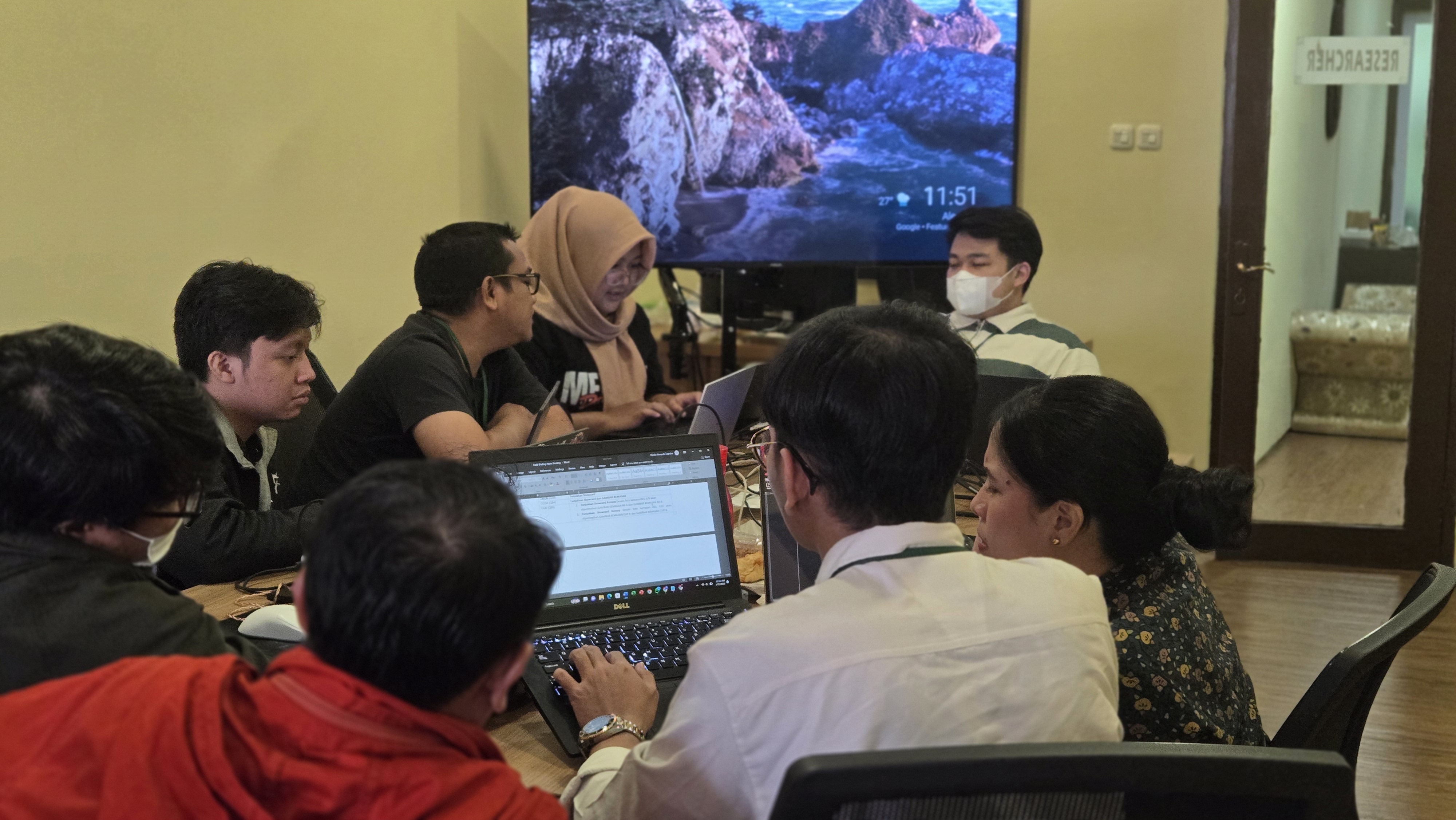
While quantitative data can tell us what is happening and how many, Myriad’s qualitative approach uncovers the meanings, motivations, and social dynamics that shape behaviours, policies, and decision-making. We help clients understand not only what is happening, but-more importantly-why, by putting people, context, and lived experience at the centre of the research process.
Our qualitative studies are built on carefully tailored research designs, aligned with the study objectives, participant characteristics, and the complexity of the issues being examined, so the insights are both contextually grounded and actionable. Depending on the research objectives, qualitative research may be used as a standalone approach or to complement quantitative findings, either independently or as part of an integrated mixed-methods design.
In-depth interviews (IDIs) are used to explore individuals’ lived experiences, perceptions, and decision-making in depth. They are particularly effective for sensitive, complex, or nuanced topics that may not surface through structured surveys or group discussions. Beyond attitudes and opinions, IDIs also enable deeper exploration of behavioural routines, usage contexts, and consumption patterns-helping clients understand not only what people do, but how and why behaviours are formed and sustained in everyday settings. Insights from IDIs often inform programme design, policy refinement, product and service development, and strategic decision-making.
In practice, clients typically choose this approach to explore lived experiences and personal narratives; understand underlying motivations, attitudes, and barriers; examine product usage habits, consumption routines, and decision triggers across different contexts; and assess policy impacts, programme outcomes, or consumer decision-making.
Key informant interviews (KIIs) engage stakeholders with specialised knowledge or strategic roles within a sector or institutional setting. This method is particularly useful for examining policy frameworks, governance dynamics, and the institutional processes that shape decision-making and implementation.
In practice, clients typically choose this approach to gain strategic insights from policymakers, practitioners, and sector experts; understand decision-making processes and power dynamics; and support policy analysis, governance studies, and stakeholder mapping.
Focus group discussions (FGDs) bring participants together to explore collective perceptions, opinion dynamics, and social norms through moderated interaction. This method captures how viewpoints are formed, challenged, and negotiated within a social context. Beyond attitudes and opinions, FGDs are also well suited to discussing shared experiences, such as product concepts, usage situations, and consumption practices, helping researchers understand how behaviours are influenced, validated, or contested within a group setting.
In practice, clients typically choose this approach to test concepts, policies, messages, or programme designs; understand community perspectives, user needs, and shared usage or consumption patterns; and generate insights through group interaction and shared experiences.
Ethnography and In-Home Visits (IHVs) are immersive methods that examine behaviours as they unfold in real life within households and everyday environments. By combining observation with in-context interviews, we capture routines, decision triggers, and the social and cultural factors that shape choices. This approach is especially valuable for product research and public health studies, where understanding how and why people act in specific settings is essential for designing solutions that work in practice.
Research is only as strong as the context it is designed for. Myriad combines deep sector expertise with rigorous quantitative and qualitative methods to turn complex field realities into clear, actionable evidence, so insights directly inform decisions and improve outcomes.
Myriad delivers data-driven insights to help organisations understand consumer behaviour, market dynamics, and category opportunities-supporting sharper marketing decisions, stronger product development, and more effective go-to-market strategies. Our experience spans food and beverage, fast moving consumer goods, automotive, pharmaceuticals, and agricultural products.
Myriad partners with public institutions, NGOs, and donors/development partners to generate evidence on social impact, community needs, and the dynamics of change. Our research is designed to support better programme design, strengthen monitoring and evaluation, and inform policy decisions grounded in data and lived realities.
Our experience spans: Education (particularly basic education research); Public Health; Agriculture and Rural Development; Gender Equality and Women’s Empowerment; Economic Empowerment and Financial Inclusion; Children, Adolescents, and Youth; Community Development; and Environment and Climate Change.
Our experience spans: education (with a strong focus on early childhood and basic education), public health, agriculture and rural development, gender equality and women’s empowerment, economic empowerment and financial inclusion, children, adolescents, and youth, community development, and environment and climate change.
Myriad supports public institutions, political consultants, and international agencies to understand political dynamics, public opinion, and policy performance. Our research helps clients identify priority issues, map stakeholders and narratives, and strengthen evidence-informed decision-making at national and sub-national levels.
Our experience includes electoral and voter research; electability and public perception studies; campaign strategy and issue mapping; and public policy and governance research across national and sub-national contexts.
Myriad helps organisations understand how technology and digital innovation are adopted, experienced, and scaled, so they can stay relevant and adapt to change. We conduct research on technology adoption, digital trends, and user behaviour to generate practical insights that inform strategic planning, product and service design, and innovation initiatives.
WhatsApp us